The Best Fence Materials for West Tennessee Weather and Soil
What our humidity, our rainfall, and our loess silt soil do to each fence material, and how to pick the one that will still look right in ten winters.
A fence material that is perfect in Arizona can be a poor choice here, and the reason has nothing to do with quality. West Tennessee has a humid subtropical climate. Hot, wet summers. Winters that swing back and forth across freezing instead of staying cold. Real rainfall all year. We sit in USDA hardiness zone 7b, and mild wet winters are harder on some materials than a hard dry freeze is.
Our ground is different too. West Tennessee's uplands are mantled in wind-blown loess, a fine silt, over the sediments of the Mississippi Embayment. Not the limestone and rock of Middle Tennessee. That is usually good news for setting posts, with its own considerations about water and support.
Add the straight-line wind that comes with storm systems crossing this part of the state, and you have the four things that decide how a fence ages here: moisture, sun, soil, and wind. Here is how each material handles them.
What the Climate Actually Does to a Fence
Humidity is the main character. Wood takes on moisture in a wet stretch and gives it up when the sun comes back, and that cycle is what cups and twists boards. Standing humidity also feeds mildew on any surface that stays shaded, which is why the north side of a fence gets dingy first.
Freeze-thaw is second. A winter that drops below freezing at night and climbs back above it by afternoon, over and over, moves water in and out of wood fiber, flexes rigid materials, and heaves saturated soil around a post.
Then sun, which fades stain and chalks anything with color in it. And wind: our worst wind comes in fast and straight with a storm front, and it cares only about how the posts were set and whether the fence lets air through.
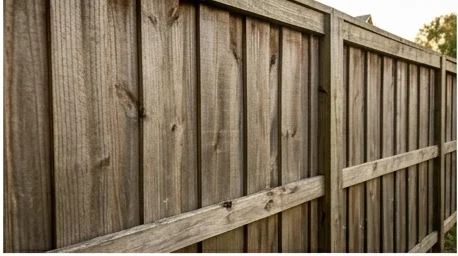
Pressure-Treated Pine
This is the workhorse of Jackson backyards and it earns the spot. Treated southern yellow pine is built for ground contact and rot resistance, which is exactly the fight it picks here. First cost is the lowest of the solid options.
The catch is movement. Pine moves with our humidity, and treated lumber usually arrives wet from the treatment process. Boards that go up soaking will shrink as they dry, so gaps open. Build with that in mind and it is not a problem. Let it dry before you seal it, then keep a finish on it, and pine gives you a solid fence for a long stretch.
Skip the finish entirely and you get a gray, cupped, splintery fence. That fence did not fail because pine is bad. It failed because nothing ever went on it. See wood fencing for how we build them.
Cedar
Cedar is naturally rot and insect resistant, it is more dimensionally stable than pine, and it smells like a good decision on install day. In a humid climate, stability is worth paying for, because stable boards stay flat and a flat fence looks straight from the street.
Cedar costs more up front than pine. Most of that comes back to you in maintenance you do not do and boards you do not replace. Left unfinished it weathers to silver gray, which some homeowners want on purpose. Sealed, it holds a warm color and resists our mildew better than bare wood does.
If you want a wood privacy fence and you plan to be in the house a long while, cedar is the material I point people toward.
Vinyl
Vinyl is a strong fit for our climate for one simple reason: humidity means nothing to it. It does not rot, it does not swell, mildew wipes off it, and insects have no interest. In a place where the main enemy is moisture, that matters.
Two things to know. Quality varies a lot, and the difference is wall thickness and whether the rails have internal reinforcement. Cheap vinyl in our summer sun and winter cold gets brittle and chalky, and a brittle panel is what cracks when a limb comes down in a storm. Buy the heavy stuff or buy something else.
The other thing is wind. A solid vinyl privacy panel is a sail. It has to be engineered as a system, with posts set properly and panels that release or flex instead of levering a post out of the ground. Done right, vinyl fencing is close to zero maintenance here, which is the main reason people choose it.
Get a free estimate
Call or text Greg at (731) 555-1234, or use the form. Photos of your yard help.
Free on-site estimates in Jackson & West Tennessee.
Aluminum and Ornamental Iron
Powder-coated aluminum is the most weather-indifferent fence material there is. Aluminum does not rust, so our humidity and our rainfall are simply not a factor. It is light, it is strong enough for residential use, and it lets wind pass straight through, which makes it a good pick for open or exposed lots.
It is also the right answer for pool enclosures, where you need a barrier that meets code and does not block the view of the water. See aluminum fencing and pool fencing for that.
True ornamental iron is heavier and more formal, and it looks like nothing else on an entry. Steel and humid air do not get along, so the finish is the whole ballgame. Keep the coating intact and touch up any nick that reaches bare metal. Ignore a chip for a few wet seasons and rust works outward from it.
Chain Link and Farm Fencing
Galvanized chain link is honest fencing. It covers ground for less than anything else, wind goes right through it, and there is nothing in it for moisture to ruin. It contains dogs, it secures a work area, and it is the standard for a reason. It is not trying to be pretty, and vinyl-coated versions read a little softer if the look bothers you.
On acreage, the material question shifts from appearance to function. Post-and-board defines a property line. Woven no-climb wire is safer around horses. Our silt soil and real rainfall mean low spots along a long run need attention, because a wire fence is only as good as the bottom of it. The farm and horse fencing guide covers those trade-offs, and split rail and farm fence shows what we build.
How I Pick for a Specific Yard
The material decision is usually easier than people expect once you answer four questions honestly:
- What is the fence for? Privacy, containment, safety around water, or looks. That alone eliminates half the options.
- How much maintenance will you actually do? Not how much you intend to do. Wood rewards attention. Vinyl and aluminum forgive the lack of it.
- How exposed is the lot? Open acreage with nothing to break the wind argues for something air passes through, or for solid panels engineered and set for the load.
- Does the low corner stay wet? Drainage changes how we treat posts, and sometimes changes the material at the bottom of the run.
If you want to know how long each one lasts here, the fence lifespan guide covers it in relative terms.
Common Questions About Fence Materials
What is the best fence material for West Tennessee humidity?
+For a maintenance-free answer, vinyl or powder-coated aluminum, because moisture does nothing to either one. For a wood fence, cedar handles our humidity better than pine because it is more stable and naturally rot resistant. Treated pine works well too, as long as it gets a finish and stays maintained.
Does wood fence warp badly around Jackson?
+It can, and the cause is our wet-to-dry swings. The fixes are practical: let treated lumber dry before sealing, use decent boards instead of the thinnest ones, fasten properly, and keep a finish on it. A wood fence that gets stained on schedule stays flat far longer than one that never does.
Will vinyl fence crack in our winters?
+Quality vinyl handles zone 7b winters fine. Thin, low-grade vinyl is the stuff that gets brittle and cracks. Wall thickness and rail reinforcement are what separate the two, so ask what grade is in your quote instead of comparing on the word vinyl.
What holds up best in storm wind?
+Anything wind passes through: aluminum, chain link, picket with gaps, post-and-board. Solid privacy fence catches wind by design, so it depends entirely on post depth, post spacing, and how it was built. The storm damage guide covers what typically goes first.
The Honest Bottom Line
There is no single best material, but there is a best material for your yard and how you live. Cedar or treated pine for a classic wood privacy fence, with the understanding that finish is part of the deal. Vinyl if you want to stop thinking about it. Aluminum for pools, views, and exposed lots. Chain link when function is the point. Wire and board on acreage.
I will walk your line and tell you what I would put there, including when the cheaper option is the right one. Serving Jackson, Three Way, and West Tennessee.
Get a free estimate
Call or text Greg at (731) 555-1234, or use the form. Photos of your yard help.
Free on-site estimates in Jackson & West Tennessee.