How to Build a Fence Your Dog Cannot Beat
Height, footing, latches, and gaps. The four things that decide whether a fence contains your dog, and how to get each one right the first time.
Containing a dog is one of the most common reasons to build a fence, and it is a different design problem than a privacy fence, because your dog is going to test it every single day while you are at work.
Dogs get out four ways: over, under, through, and by opening the gate. Most fences that fail are solid on three of those and wide open on the fourth. A six-foot privacy fence with a gap at the bottom is a six-foot fence with a dog-sized door in it.
So the dog comes before the material. Size, age, energy level, whether it climbs, whether it digs, and whether it has already escaped something. That last answer tells you the most.
Height: Match It to the Dog, Not the Yard
Height is the first decision and the one people underbuild. Small breeds and low-energy dogs are contained by a modest fence. Medium athletic dogs need real height, more than most homeowners guess by looking at the dog standing still. A dog's standing height tells you very little about its jumping height.
The tall, athletic working and herding breeds are in their own category. If you have a dog that was bred to work all day, build for the high end of what the ordinance and your budget allow, and treat height as the floor rather than the goal. Sight hounds and the long-legged mixes clear more than you expect from a standstill.
Two habits matter more than the breed name. If your dog is a climber, height alone will not solve it, because a climber uses the fence as a ladder. If your dog is a launcher, height is exactly the answer. Watch which one you have before you decide.
Climbers Need a Surface With No Footholds
A climbing dog needs a toe hold, and horizontal rails on the inside face of a fence are a staircase. This is the most common design mistake on a dog fence, and it happens on fences that are plenty tall.
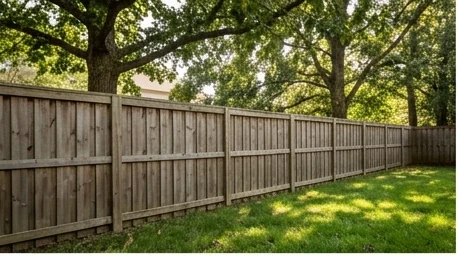
Solid-face fencing solves it. A wood privacy fence or a vinyl privacy fence with the smooth side facing the dog gives nothing to grip. Which is convenient, because inside the City of Jackson the finished side has to face your neighbors and the street anyway. That rule and a climbing dog want the same thing.
Chain link is the other classic climbing surface, since the mesh is a perfect ladder. It still works for plenty of dogs, and it is the most economical way to enclose a large area. If your dog climbs, though, chain link is not the pick, or it needs a solid panel or an inward-angled top treatment to change the geometry.
Diggers Need Something Below Grade
A digging dog does not care how tall the fence is. It goes under. Our soil around here is a fine silt, which digs easily, so this is worth planning for in a Jackson yard.
The three approaches that work, from lightest to most permanent:
- Buried wire apron. Hardware cloth or welded wire fastened to the bottom of the fence and buried along the line, sometimes turned outward in an L under the sod. It stops most casual diggers and it disappears once the grass grows back.
- Concrete mow strip. A narrow ribbon of concrete poured along the fence line, set slightly below grade. It is the permanent fix for a determined digger, and it makes trimming along the fence easier for the rest of the fence's life.
- Gravel trench. A trench of compacted stone under the fence line. Less visible than concrete and unpleasant to dig into. A good middle option.
Also close the gaps you did not mean to leave. Solid fences on sloped ground get a triangular gap under each panel where the ground falls away, and a dog finds that in about a day. Either step the fence with the grade or fill those voids as part of the build.
Get a free estimate
Call or text Greg at (731) 555-1234, or use the form. Photos of your yard help.
Free on-site estimates in Jackson & West Tennessee.
Gates and Latches Are Where Smart Dogs Win
The gate is the weak point in every dog fence, for two reasons. It has hardware that can be worked, and it gets opened by people who do not always check it.
Get a self-closing hinge and a self-latching latch. A gate that closes and latches itself removes the human factor, which is the actual cause of most escapes. Then put the latch release on the outside, high enough that a tall dog cannot reach it with a nose or a paw, and add a spot for a carabiner or a small lock if your dog is the type that studies mechanisms. Some of them do.
Check the gap along the hinge side and under the gate. Gates need clearance to swing, and clearance is a hole. A drop rod or a threshold at the bottom closes it. Our gate installation and repair work handles the hardware side of this, and it is worth spending on good hardware for a gate that gets used several times a day.
Layout Choices That Reduce Barking and Fence Fighting
Containment is only half the job. A reactive dog that can see every person, dog, and car going past will bark at all of them, and that habit gets worse with practice.
Solid privacy fencing on the street or sidewalk side cuts the visual triggers and often quiets a dog down considerably. Where you have a neighbor with a dog on the other side, a solid fence also stops the back-and-forth running along the line that wears a dirt trench in the grass and occasionally ends in a bite through a gap.
Consider size too. A fence around the whole property sounds generous, but a smaller, well-built run closer to the house is often the better dog yard: less line to patrol, less fence to maintain, and no far corner where your dog is out of earshot. Sometimes the right answer is both, with a split rail or farm fence on the perimeter and a proper dog enclosure near the house.
Common Questions About Dog Fences
How tall should a fence be to keep my dog in?
+It depends on the dog more than the breed chart. Small and low-energy dogs are fine with a modest fence. Athletic medium and large dogs need real height, and working breeds need the tall end of what your ordinance allows. If your dog has already cleared a fence, build taller than the one it beat.
What is the best fence material for dogs?
+Solid-face wood or vinyl privacy fence, because there are no footholds and no sight lines to bark at. Chain link is the economical way to enclose a big area and works well for dogs that neither climb nor dig. Ornamental aluminum works if the picket spacing is right for your dog's size.
How do I stop my dog from digging under the fence?
+Put something below grade. A buried wire apron stops most diggers, and a concrete mow strip along the fence line stops the determined ones. Fill any gap that opens under a panel where the ground slopes away.
Do I need a permit for a dog fence in Jackson?
+Inside the city limits a fence permit is required for fence installation, and the corner-lot and front-yard vision rules apply regardless of why you are building it. See the permits guide for what the application needs.
Can you add height to the fence I already have?
+Sometimes. It depends on whether the existing posts can carry more height and wind load, and whether the posts are sound. If they are, an extension can work. If they are not, you are building on a bad foundation. The repair or replace guide covers how to check.
The Honest Bottom Line
Build for the dog you actually have. Height for a jumper, a smooth face for a climber, something below grade for a digger, and a self-closing gate with a latch out of reach for the clever ones. Get those four right and the fence holds.
Tell me about your dog when you call and I will tell you what I would build. Serving Jackson, Medina, and West Tennessee. If you want to see the styles, start with privacy fencing.
Get a free estimate
Call or text Greg at (731) 555-1234, or use the form. Photos of your yard help.
Free on-site estimates in Jackson & West Tennessee.