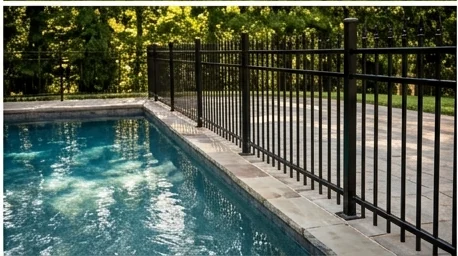
Pool Fence Requirements in Tennessee and What Inspectors Look For
The barrier details that decide whether a pool fence passes, and the phone number to call before you buy material.
A pool fence is the one fence where the rules matter more than your taste. Everything else on your property is a preference conversation. A pool barrier is a safety system, and it either works as one or it doesn't.
Here's the part we want to be straight about up front. Pool barrier requirements come from a mix of state law and whichever edition of the building code your jurisdiction has adopted, and they get updated. We're not going to quote you a height in inches or a code section number off this page, because the number that matters is the one your local building department is enforcing the day you pull the permit, not the one that was current when somebody wrote a blog post.
What we can do is tell you what inspectors consistently look at, so you know what you're designing toward before you spend money.
Get a free estimate
Call or text Greg at (731) 555-1234, or use the form. Photos of your yard help.
Free on-site estimates in Jackson & West Tennessee.
Call the county first, not last
The Madison County Building Department is at 100 E Main St, Suite 100 in Jackson. The number is (731) 423-6014. Call them and ask directly what the current pool barrier requirements are for your address, and whether your project falls under the county or the City of Jackson.
Madison County has adopted the 2018-edition international codes, which is the family that governs residential pool barriers among a lot of other things. Editions get replaced over time, and the details within them move. Ask. Write down what they tell you. Ten minutes on that call is the cheapest step in the whole project.
If your property is inside Jackson city limits you're also pulling a city fence permit, which has its own requirements including a certified boundary survey or a signed neighbor agreement. Our Jackson and Madison County permit guide walks through that side of it.
What inspectors look for
Across jurisdictions, the same handful of things get checked. If your barrier handles all of these, you're in good shape before you even get the specific numbers:
- Height that a child can't get over. Measured from the outside, on the ground a child would actually be standing on. A fence that's tall enough on the flat and short on the high side of a slope is a problem.
- Gaps a small body can't get through. Under the bottom rail, between pickets, and between the barrier and any adjacent structure. This is the detail that most often fails an inspection, and it is usually the bottom gap on uneven ground.
- Nothing climbable on the outside face. Horizontal rails at a reachable height, decorative scrollwork, a lattice panel, a retaining wall or a landscape boulder set against the fence. Inspectors look at what a determined four-year-old could use as a step. So should you.
- Gates that close themselves. Self-closing hardware, so the gate shuts without anybody remembering to shut it.
- Gates that latch themselves. Self-latching hardware, positioned so a child can't reach it, and mounted on the pool side where that's called for.
- Gates that swing away from the pool. Outward-opening, so a child pushing on it closes it rather than opening it.
- The house counts as part of the barrier. If a door or a window opens directly into the pool area, that opening is part of the enclosure and gets its own requirements. This catches people off guard constantly.
Nothing on that list is exotic. What trips homeowners up is treating the pool fence like a regular fence and discovering at inspection that the hardware, the gate swing, and the ground clearance all need redoing.
Which materials suit a pool barrier
Ornamental aluminum is the usual answer around a pool, and the reasons are practical. Vertical pickets with nothing horizontal in the climbable zone. Powder-coated finish that doesn't mind chlorine, splash, or a humid Jackson summer. Sight lines so you can see the water from the patio, which is a safety feature of its own. It won't rust, which matters right next to water. See aluminum fencing for the detail.
Ornamental iron and steel give you the same open look with more mass, and they'll want the coating maintained where it gets chipped. Vinyl comes in barrier-appropriate configurations but you need to check the specific system against the gap and climbability rules, not assume. Board privacy fence can serve as a pool barrier where it's built to the right height with no climbable rail on the outside, and an existing privacy fence often ends up as one side of the enclosure.
Chain link is the one we'd steer you away from for a pool. The mesh itself is a foothold. Some jurisdictions restrict it for that reason. Our pool fencing service page covers what we build and how we handle the barrier details.
Where pool fences actually fail inspection
The bottom gap on sloped ground. A yard that drops away means the panel that sat tight to grade at one end has a gap at the other. On a pool barrier that gap is not cosmetic. It gets solved with stepped panels and a properly set bottom, and either way it needs to be planned rather than discovered at inspection.
Gate hardware substitutions. Somebody swaps the self-closing hinge for a standard one because it was on the shelf. Or the latch gets mounted at a convenient height instead of a compliant one.
Things placed next to the fence after inspection. A planter, a firewood stack, a deck box, a trampoline. The barrier passed and then somebody built a step next to it. That one is on the homeowner and it's worth knowing about.
Gate swing. It's a two-minute decision at install and an expensive one to reverse if the posts went in wrong.
How we handle pool fence work
We walk the enclosure line with you before quoting, because a pool barrier is a system and the corners are where it gets decided. Where the gates go. Which direction they swing. What the ground does along each run. Whether the house wall or an existing fence is doing part of the work.
We build to what the building department tells you, not to what we assume. If you haven't made that call yet, make it before we finalize a layout. We'll happily wait on it, and we'd rather wait than rebuild.
Questions we get about pool fences
Do I need a fence around an above-ground pool in Tennessee?
+Often yes, depending on the pool's own wall height, whether the ladder is removable, and how your jurisdiction applies the barrier rules. Don't assume above-ground exempts you. Call the Madison County Building Department at (731) 423-6014 and describe your specific setup.
Can my existing privacy fence count as the pool barrier?
+Sometimes. It has to meet the height, gap, and climbability requirements, and the gates have to be self-closing, self-latching, and swing away from the pool. Most existing back-yard fences fail on the gate hardware alone. That's usually a fixable retrofit rather than a rebuild.
Which fence material is best around a pool?
+Ornamental aluminum, in most cases. It resists corrosion next to water, has no horizontal rail in the climbable zone in most designs, and keeps sight lines to the pool open. See aluminum fencing for the detail.
Does a pool fence need a permit in Jackson?
+The City of Jackson requires a fence permit for fence installation generally, and a pool enclosure is also a safety barrier subject to building code review. Handle both. The permit guide covers the city application, and the county building department covers the barrier side.
The honest bottom line
We're a fence company. We build the barrier and we build it to the requirement you've confirmed. We are not the authority on what that requirement is, and we won't pretend to be, because the consequence of being wrong here is not a re-inspection fee.
So: call (731) 423-6014, get the current pool barrier rules for your address in writing if you can, and then let's design to them. If you want to talk styles in the meantime, the fence styles guide and our Jackson fence installation page are good places to start.
Get a free estimate
Call or text Greg at (731) 555-1234, or use the form. Photos of your yard help.
Free on-site estimates in Jackson & West Tennessee.